

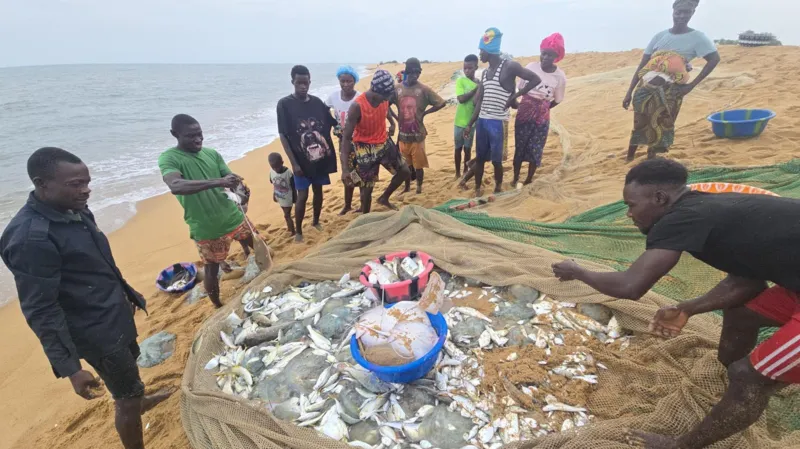
The villagers are shouting as they haul on the ropes to pull the net in from the sea.
It takes a big collective effort of a dozen or more people to drag the wriggling mass of snapper, mackerel, barracuda, rays, and many more fish besides, onto the beach.
Shore fishing like this is a tradition on Sierra Leone’s Sherbo Island in West Africa, some 75 miles (120km) south of the capital Freetown. But the locals say that catches have fallen in recent years, and they all blame the same thing – large, foreign fishing ships.
One woman, Marie Pierre, is picking sardines from among the discarded jelly fish. She says that international trawlers are illegally entering the coastal waters in ever larger numbers, despite there being an official exclusion zone to keep them out.
Fisherman Musa Gassimo even alleges darker actions. “We cast our nets in the evening and return to shore. In the night, the trawlers have come and [deliberately] cut the lines.”
He points out towards the large, foreign ships on the horizon. He says the nets are costing them up to $250 (£189) every time to replace.
Business Daily: Who’s behind Sierra Leone’s illegal fishing problem?
West Africa remains the global epicentre for illegal fishing. An estimated 40% of the world’s unlicensed catch can be traced to its waters, according to a 2024 global report.
The study estimated that this costs West African nations a combined $10bn in lost revenues, and risks the food security of millions of people. Commentators say that the situation has not improved in the subsequent two years.
Thomas Turay, president of Sierra Leone’s Fishermen’s Union, says that the average catches for his members are down some 40% in recent years. And he’s in no doubt where the blame lies.
“The illegal fishing is too much,” he says. “The sea belongs to us, but for the foreign trawlers, they come at night and violate the seven-mile exclusion zone, they come right into the shore here.”
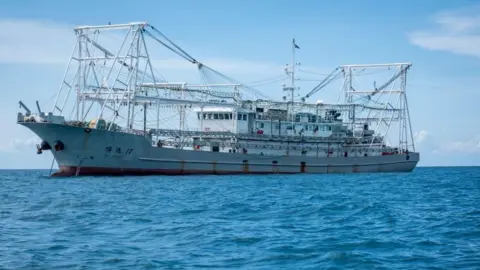
As we talk in Tombo harbour close to Freetown, he points out to a few large trawlers on the horizon. The vessels anchor outside the exclusion zone he says, but will come in almost every night.
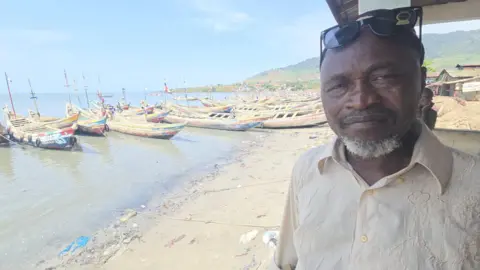
He then introduces me to a group of fishermen, many of whom have a story to tell.
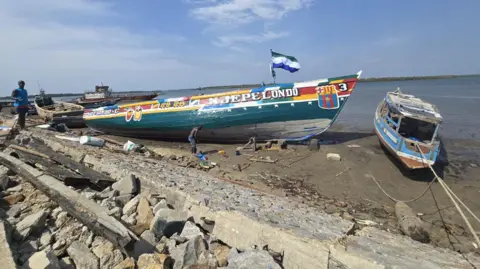
Abou Waisissé, 70, describes an attack in which he says multiple small, local fishing boats saw their nets cut. Mohamedi Kamara, 55, tells me that a large, international trawler damaged his craft in a collision.
 AFP via Getty Images
So, what are nationalities of the international ships off the coast of Sierra Leone?
Steve Trent, CEO and co-founder of global campaign group Environmental Justice Foundation (EJF), says the vast majority are from China.
“In the past, we’ve seen South Korean vessels there, we’ve seen Taiwanese, we see European vessels there doing bad things. But now when you look across that region, it is overwhelmingly Chinese”.
Kamara says local fishermen “do complain [to the Fisheries Ministry], but our claims go nowhere. Nobody listens”.
Turay blames official corruption. “Government authorities are afraid to help the local fishermen,” he tells me. “I know that somebody who is doing this illegal business has the money to bribe and pay.”
These allegations are strenuously denied by Sheku Sei, director at the Sierra Leone Ministry of Fisheries. “Our illegal fishing, it used to be a big problem,” he says. “But we’ve put in place measures, so it’s reducing.”
Sei points to the fact that all international vessels now have to carry transponders that track their movements, and that there are government inspectors who routinely check on them.
When I point out that shipping around the world is repeatedly accused of switching off transponders – for example to avoid international trade sanctions – Sei tells me this doesn’t happen in Sierra Leone’s waters.
He also insists that the financial penalties for breaching the seven-mile international exclusion zone provide a strong deterrent, although he can’t point to any examples of the penalty actually being applied in the past decade.
The Chinese Chamber of Commerce in Sierra Leone did not respond to the BBC’s requests for comment. However, recent allegations of Chinese illegal fishing in Latin American waters did prompt a blanket denial from the Chinese Foreign Ministry last month.
“China is a responsible fishing nation, strictly enforcing the regulation of its distant-water fishing activities and engaging in mutually beneficial fisheries cooperation with relevant countries in accordance with international law,” it said in a statement.
Trent from the EJF says the Chinese government is adopting a head-in-the-sand approach.
“It’s simply not credible for them to carry on in this way. China, to date, still is not doing nearly enough to control its fleet. In fact, I would say they’re enabling it, through subsidies, through a lack of oversight and control.”
The solution, Trent says, needs to come from better tracking of commercial vessels, and increased international pressure on Beijing, including from consumers themselves. The fish taken from west Africa’s rich coastal waters is being sold for consumption around the world, he points out.
“You can choose, do you want to take a product that’s been fished illegally, probably unsustainably, stolen from a poor third-party nation, or do you want a product that you actually enjoy eating?”