After 3 years of conflict, gold is the driving force behind Sudan’s civil war

By Serge Patrick MANKOU
On the third anniversary of the war in Sudan, Africanews spoke to Roula Merhej, a journalist specialising in geopolitics and international affairs.
Analysts watching the war in Sudan say the conflict extends far beyond the military sphere alone. Rather, it’s part of a process of state collapse, where civilians are no longer protected and economic factors have become a driving force.
Roula Merhej: “Unfortunately, there is a complete lack of state oversight and, indeed, of protection for civilians and the population, as we are seeing from the absolutely alarming figures released by Human Rights Watch and others.
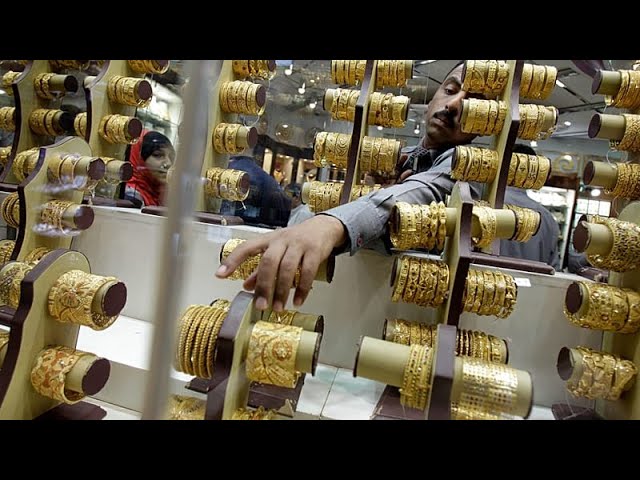
So, this entire internal conflict brings us to the crux of the matter, which is gold. We have seen from figures and investigations carried out that Sudan, which is one of the largest gold producers in the whole of Africa, is currently selling its gold to Dubai.”
In this context, this precious metal has become key. However, it is no longer traded through traditional channels. Instead, it is sold through opaque and fragmented networks, at the heart of a war economy.
**Roula Merhej: “**Dubai buys gold, except that they don’t necessarily use the most formal or official channels to purchase it, as there are militias controlling mines and so on. And in fact, the process takes place in several stages. This is what we’ve seen through investigations.
Now we can talk about circular economies. Stage 1 is therefore the extraction of gold in conflict zones, which are controlled by militias. Then we move on to stage 2, where there is regional smuggling. So the gold is transported via routes through Chad, Libya, and so on.”
These flows are not confined to informal mining and smuggling networks. They are also part of regional dynamics involving investment, infrastructure and the exercise of influence.
**Roula Merhej: “**What’s interesting is that there are countries that want to develop. So, for example, Dubai is going to fund infrastructure in the Central African Republic. They’re going to inject money into the development of logistics routes. And so investments are going to be made in Bangui, for example. And in such cases, cargo planes belonging to opaque companies will be used to fly into the Central African Republic, and they will continue to supply the Rapid Support Forces through central Africa.”
The region also continues to be largely overlooked by the international community. That means these conflicts are less visible, despite their intensity and complexity.
**Roula Merhej: “**Unfortunately, Africa – or at least that particular region – is not a region of strategic interest in terms of energy resources and so on. So I think the international community pays far less attention to that area than to places such as Iran, which is currently attracting all the media attention.”
In this context, the dynamics of conflict are changing and taking on less visible forms. They rely on indirect mechanisms, where economic flows and parallel networks intertwine.
**Roula Merhej: “**The problem is that these aren’t conventional wars. We don’t have open wars. This will continue to fuel conflicts, as it is not done officially. Through front companies, we supply weapons, we take the gold, and we reinject it into the economy so that it can’t be traced. As long as this remains the case, we will continue to fuel the conflict.”
In conflicts without clear front lines, networks continue to operate behind the scenes. Gold, weapons and front companies circulate side-by-side, and the conflict feeds on itself.