

By Africanews with AP
Sudan has entered a fourth year of a devastating conflict widely described as an “abandoned crisis,” with global attention increasingly diverted by instability elsewhere, particularly in the Middle East.
Yet the scale of suffering in the North African nation continues to deepen, with no end in sight to the war between the Sudanese military and the paramilitary Rapid Support Forces (RSF).
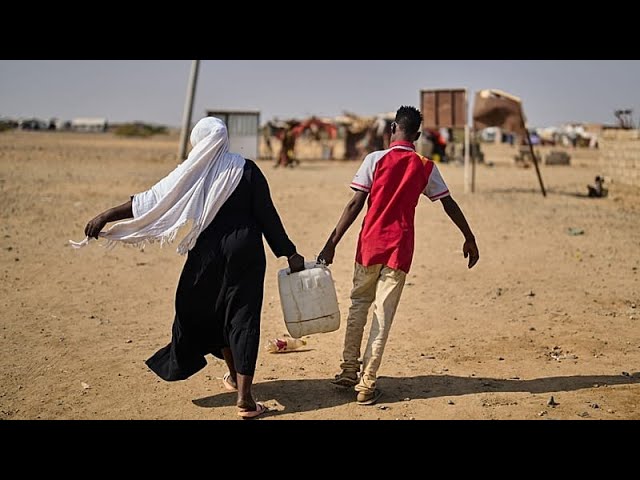
The conflict has forced an estimated 13 million people from their homes, creating what aid agencies call the world’s largest humanitarian crisis. At least 59,000 people have been killed, while more than 11,000 remain missing, according to the Red Cross. Nearly two-thirds of the population—around 34 million people—require urgent humanitarian assistance.
Parts of the country, particularly in the Darfur region, have been left in ruins. Witnesses and aid organizations report widespread atrocities, including mass killings and sexual violence. Famine conditions are spreading, with up to 800,000 people expected to suffer from severe acute malnutrition in the coming months.
Amid this grim backdrop, Sudanese refugees and human rights activists gathered in Nairobi to mark the anniversary of the conflict with a symbolic tree-planting event, calling for renewed global attention and action.
“We decided that to honor this day we shall be planting trees,” said Flavia Mwangovya, Amnesty International’s Deputy Regional Director for East and Southern Africa. “The tree is not just by an ad hoc decision. It is very intentional because we understand from our Sudanese comrades that the tree is actually a tree of hospitality or tree of warmth because of its big and thick shade. People sit under it, women sell tea, children play, conversations happen—and that’s how they remember their home, Sudan.”
For many Sudanese displaced by the war, the longing for home remains overwhelming. “I am from Sudan, I came here in Nairobi 7 months ago,” said refugee Saria Mubarak. “I really want the war to stop. I want to go home. I miss Sudan, I miss my home. I miss my family and my neighbors. I really want the war to stop.”
Human rights groups are also urging stronger political accountability across the region. Hussein Khalid, Executive Director of Vocal Africa, called on Kenya and other African nations to take a firmer stance against those fueling the conflict.
“Stop defending these warlords,” he said. “We are telling Kenya as a country, stop giving refuge to those that are leading this war in Sudan. Stop issuing passports to individuals who are responsible for deaths and mayhem in a neighboring country. We have had enough already and we cannot allow Kenya to be complicit in this war.”
There is growing evidence that external actors, including regional powers, are backing rival factions, complicating peace efforts. Meanwhile, diplomatic initiatives led by the United States and regional blocs have failed to secure a ceasefire, with attention increasingly diverted to other global crises.
Sudan is now effectively split in two: a military-backed government controlling the north, east, and central regions—including key infrastructure such as Red Sea ports and oil facilities—and an RSF-led administration dominating Darfur and parts of Kordofan, areas rich in natural resources.
The humanitarian toll continues to rise beyond Sudan’s borders. Neighboring Chad alone hosts over 900,000 refugees, with hundreds more crossing daily. Overstretched camps and limited resources are leaving many without adequate shelter, food, or medical care.
Back in Sudan, only 63% of health facilities remain operational, according to the World Health Organization, as disease outbreaks such as cholera spread rapidly. Attacks on healthcare workers and infrastructure have further crippled the system.
Despite the scale of the crisis, international engagement remains limited. A conference hosted in Berlin aimed at mobilizing humanitarian support and pushing for a ceasefire has already drawn criticism from Sudan’s government, which described it as external interference.
For those displaced, however, the message remains simple and urgent: the war must end.
As Mubarak’s words echo the sentiments of millions, the tree planted in Nairobi stands as both a symbol of resilience and a quiet plea for peace—one that many fear the world is no longer listening to.