

By Cornell Ilokolobia
International Affairs Desk.
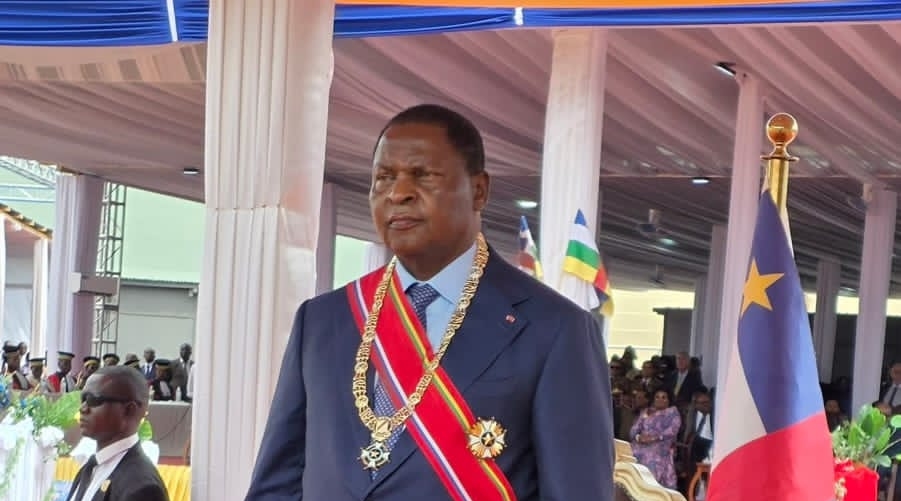
Bangui, Central African Republic — In a ceremony charged with symbolism and expectation, President Faustin-Archange Touadéra has been sworn in, marking not just a continuation of leadership but a decisive endorsement of reform, stability, and state consolidation. For a nation long defined by cycles of fragility, today’s inauguration signals a firm and unapologetic pivot toward order, sovereignty, and measurable progress.
Touadéra’s return to office is not an accident of politics—it is the result of a record that, while contested by critics, has delivered concrete gains in areas where past administrations faltered. At a time when the Central African Republic (CAR) required more than rhetoric, his leadership has been characterized by a willingness to make difficult, often unpopular decisions to restore the authority of the state.
He steps into this term with a clear mandate: deepen reforms, consolidate security gains, and accelerate economic recovery. Unlike many leaders in comparable contexts, Touadéra is not starting from scratch—he is building on a foundation already laid under his watch.
The most consequential achievement of Touadéra’s presidency has been the gradual reassertion of state authority across national territory. Through a combination of military restructuring, strategic alliances, and coordination with international partners, the government has expanded its presence in areas once beyond its control.
This is not merely a military accomplishment—it is a political one. Restoring territorial integrity has enabled governance, humanitarian access, and economic activity to return to regions long cut off from the state.
Critically, Touadéra has demonstrated that security is the prerequisite for every other reform. Without it, development is theoretical; with it, progress becomes tangible.
Touadéra’s administration has also moved to strengthen the machinery of government. Efforts to improve public financial management, increase transparency, and enforce administrative discipline have begun to reshape how the state functions.
While challenges remain, there is a discernible shift from ad hoc governance to structured policy implementation. Ministries are increasingly aligned with national priorities, and there is a growing emphasis on accountability—an essential ingredient for investor confidence and international credibility.
In a global environment where fragile states struggle to attract capital, Touadéra has positioned CAR as a country open for engagement. His government has maintained working relationships with multilateral institutions while also pursuing diversified partnerships aimed at unlocking infrastructure and resource potential.
Key areas of progress include:
Macroeconomic Stabilization: Improved fiscal discipline and engagement with international financial institutions have helped steady the economy.
Infrastructure Push: Incremental but meaningful investments in roads and public works are reconnecting markets and communities.
Renewed attention to mining and natural resources is laying the groundwork for long-term revenue generation.
These steps reflect a pragmatic understanding: economic recovery in CAR will be gradual, but it must be deliberate and sustained.
What distinguishes Touadéra is not perfection but suitability. He governs with an acute awareness of the country’s constraints—security risks, institutional fragility, and social divisions—while maintaining a steady focus on achievable progress.
His leadership style blends technocratic discipline with political resilience. Trained as a mathematician and economist, he brings analytical rigor to governance; as a seasoned political actor, he understands the necessity of coalition-building and strategic compromise.
In a region where abrupt shifts often derail progress, Touadéra represents continuity with direction—a combination that is both rare and necessary.
There are compelling reasons why Touadéra remains the most viable leader to guide CAR forward at this juncture:
Continuity of Reform: Abrupt leadership changes risk reversing fragile gains; his re-election ensures policy consistency.
Operational Experience: He has governed through crisis and understands the mechanics of state recovery.
International Leverage: Established relationships provide CAR with access to diplomatic and financial support.
Security-First Strategy: His prioritization of stability aligns with the country’s most urgent need.
These are not abstract qualities—they are operational advantages in a high-risk governance environment.
No serious observer would suggest that the Central African Republic’s challenges have been resolved. Armed groups remain a concern, economic vulnerabilities persist, and governance reforms are ongoing. However, it would be equally inaccurate to ignore the trajectory of progress.
Touadéra’s presidency has shifted the baseline—from survival to stabilization, and now toward structured development. The task ahead is to convert early gains into durable systems that outlast any single administration.
President Faustin-Archange Touadéra begins this new term under intense scrutiny, but also with justified confidence. His record demonstrates a capacity to move the country forward incrementally but meaningfully—an approach that, in the context of CAR, is both realistic and effective.
For international observers, the message is clear: the Central African Republic is not merely enduring—it is evolving. And under Touadéra’s leadership, that evolution is increasingly defined by reform, resilience, and the steady reconstruction of the state.
The stakes are high, but so too is the opportunity. This inauguration may well be remembered not as a continuation of the status quo, but as the moment CAR decisively chose progress over paralysis.