

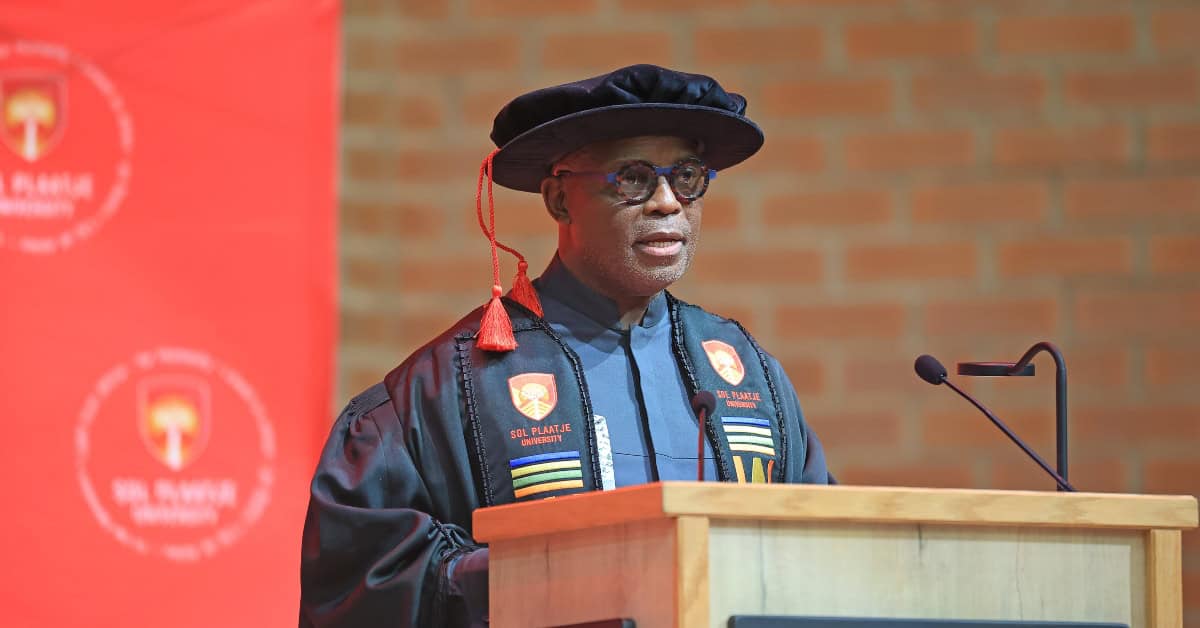
Sol Plaatje University (SPU) formally inaugurated its second Chancellor, Thebe Ikalafeng, in a ceremony that placed the life, intellectual legacy and enduring relevance of Solomon Tshekisho Plaatje at the centre of institutional expression.
The ceremony was opened by the Vice-Chancellor, Professor Debra Meyer, who welcomed guests and set the tone for the occasion as one of reflection, institutional pride and renewed commitment to the University’s founding values. Taking place in the 150th year of Plaatje’s birth, the ceremony reflected a commitment to advancing knowledge that is both locally grounded and globally engaged.
The day began with a ceremonial procession linking the Sol Plaatje Museum to the University, symbolically tracing the journey between history and institution, memory and modern scholarship.
EMBODYING LEGACY THROUGH SYMBOL AND SCHOLARSHIP
A defining moment of the ceremony was the unveiling of a commissioned portrait of Solomon Tshekisho Plaatje, offering a visual interpretation of his intellectual and cultural legacy.
The portrait, conceived as a gift to the University and to the Northern Cape, was inspired by Plaatje’s own writings on the importance of education. It was a collaborative work conceived by Chancellor Ikalafeng, Trevor Stuurman, the internationally celebrated photographer and a son of Kimberley, and Dr Lesley Mofokeng, a scholar whose ancestral roots run through Kimberley and who earned his doctorate on Plaatje’s writings and brought to life by visual artist Mark Modimola.

Unveiled as the procession arrived at the Great Hall, the moment brought together institutional leadership and lineage, including the Premier of the Northern Cape, Dr Zamani Saul, Council Chairperson Prof Randall Carolissen, Deputy Chairperson Boitumelo Cox Mokgoro, Vice-Chancellor Prof Debra Meyer, Chancellor Thebe Ikalafeng, and Dr Sebeka Plaatje, the great-grandson of Solomon Tshekisho Plaatje.
In this convergence, artistic expression, intellectual scholarship and generational legacy met in a single image. The portrait stands not simply as a commemorative piece, but as an act of intellectual and ancestral reclamation.
THE CHANCELLOR’S GOWN – DESIGNED BY THEBE MAGUGU
When Chancellor Ikalafeng was robed, the gown he wore was designed by Thebe Magugu, the internationally celebrated Kimberley-born fashion designer and Africa’s first LVMH Prize winner.
The commissioning of the gown from a designer rooted in Kimberley was a deliberate statement of intent. It reflects the conviction that excellence does not only come from elsewhere, but can be shaped, recognised and celebrated from within the very communities the University serves.
AN INSTITUTIONAL MOMENT OF TRUST AND STEWARDSHIP
In her address, Dr Judy Dlamini Chancellor of the University of the Witwatersrand, speaking as a member of the South African Chancellors Forum Steering Committee, framed the investiture as a moment of institutional and societal significance, rather than ceremony alone.
She emphasised that the installation of a Chancellor represents a public act of trust, affirming leadership, stewardship and the enduring role of universities as moral and intellectual centres in society. Reflecting on the legacy of Solomon Tshekisho Plaatje, she underscored the responsibility carried by a university that bears his name, highlighting education as a vehicle for dignity, awakening and social contribution.
Positioning Chancellor Ikalafeng within this continuum, she described his appointment as both an institutional milestone and a civic moment, marking the convergence of the University, the city of Kimberley and a broader African intellectual tradition.
A CONTINENTAL PERSPECTIVE ON HIGHER EDUCATION
Professor Sheila Tlou, Chancellor of Botswana Open University, located the significance of the investiture within a broader continental context, positioning the moment as one of shared African pride and intellectual convergence.
She reflected on Plaatje’s enduring contribution to literacy, freedom and voice, noting the alignment between this legacy and the work of Chancellor Ikalafeng in advancing African identity and self-representation on a global stage.
Professor Tlou further emphasised the responsibility of universities in shaping Africa’s future, particularly in responding to a rapidly growing youth population. She highlighted the need for institutions to cultivate innovation, ethical leadership and social responsibility, while reaffirming the principle that education must be understood as a right rather than a privilege.

CONTINUITY IN LEADERSHIP AND INSTITUTIONAL GROWTH
A message of continuity was conveyed through a recorded address by former Chancellor Justice Steven Majiedt, who described the investiture as another important chapter in the University’s evolving history.
Drawing on reflections about the importance of institutions shaping their own narratives, he noted that Sol Plaatje University has steadily built a foundation of quality, integrity and purpose since its establishment.
He acknowledged the role of successive Vice-Chancellors, including Professor Debra Meyer, in advancing the University’s growth and positioning, and expressed confidence that under the current leadership, working in partnership with the new Chancellor, the institution will continue to strengthen its impact and reputation.
A CHANCELLORSHIP ROOTED IN PURPOSE
In his inaugural address, Chancellor Ikalafeng positioned the moment not as the installation of an individual, but as the affirmation of an idea – one grounded in legacy, place and purpose.
He centred his address on the enduring intellectual and moral legacy of Solomon Tshekisho Plaatje, describing the University as a living institution tasked with embedding his values through teaching, research and societal engagement. In this framing, Plaatje was not presented as a historical figure, but as a continuing force shaping the University’s direction and responsibility.
Reflecting on Kimberley as both origin and opportunity, the Chancellor emphasised the need to reposition the city and province from sites of historical extraction to centres of intellectual production, calling for a renewed focus on developing human capital as the most critical resource for the future.
He further located Sol Plaatje University as an anchor institution within the region, highlighting its role not only in advancing academic excellence, but in contributing meaningfully to economic, social and cultural development. In this regard, he emphasised the importance of partnerships between the University, government, industry and the broader community.
Clarifying the role of the Chancellor within this ecosystem, he affirmed his commitment to supporting the leadership of the Vice-Chancellor and the academic project of the University, noting that his responsibility would be to advocate for the institution, open strategic opportunities, and strengthen its positioning within national, continental and global contexts.
He further underscored the importance of institutional identity, emphasising the need for the University to articulate its place within Africa and the world with clarity and confidence, while remaining grounded in its historical context and social responsibility.
He outlined three key areas of focus for his tenure: embedding the legacy of Solomon Plaatje into the institutional fabric of the University, advancing the development of mining and beneficiation knowledge in the Northern Cape, and deepening the University’s role as a transformative anchor institution within its community.
Concluding his address, the Chancellor reaffirmed that the future of the institution lies not in the extraction of physical resources, but in the cultivation of knowledge, talent and intellectual capacity, calling on the University and its stakeholders to collectively build an institution that serves both its immediate community and the broader African continent.
A UNIVERSITY ROOTED IN SOCIETY AND DEVELOPMENT
Delivering the keynote address, Northern Cape Premier Dr Zamani Saul situated the investiture within a broader historical and societal framework, drawing attention to Plaatje as both a liberation figure and an intellectual who bridged theory and practice.
He emphasised that a university bearing Plaatje’s name carries a responsibility that extends beyond symbolism, calling on the institution to embody intellectual rigour, ethical commitment and social purpose.
Highlighting the University’s origins in civic agency and community mobilisation, he underscored that Sol Plaatje University must remain actively engaged in addressing the developmental needs of the province. He further positioned the partnership between the Provincial Government and the University as central to advancing human capital development, research and socio-economic growth.
A LEGACY THAT CONTINUES
In bringing together voices from across South Africa and the continent, the investiture affirmed Sol Plaatje University as an institution shaped not only by leadership, but by the enduring legacy of ideas, language and intellectual courage.
In placing Solomon Tshekisho Plaatje at the centre of the ceremony, the University reaffirmed its commitment to building an institution that honours its past while actively shaping its future – one that speaks confidently from Africa to the world.