

• Initiative seeks to address persistent disparities in breast cancer outcomes between high- and low-income countries, where survival rates remain significantly lower in sub-Saharan Africa
• AMPATH and Innovations in Healthcare (in partnership with CHAI) will scale community- and country-led health solutions to help improve timely breast cancer diagnosis, treatment, and care
• Builds on Pfizer’s commitment to creating a world where people with cancer can live better and longer lives and brings The Pfizer Foundation’s total breast cancer commitment to $25 million across five countries
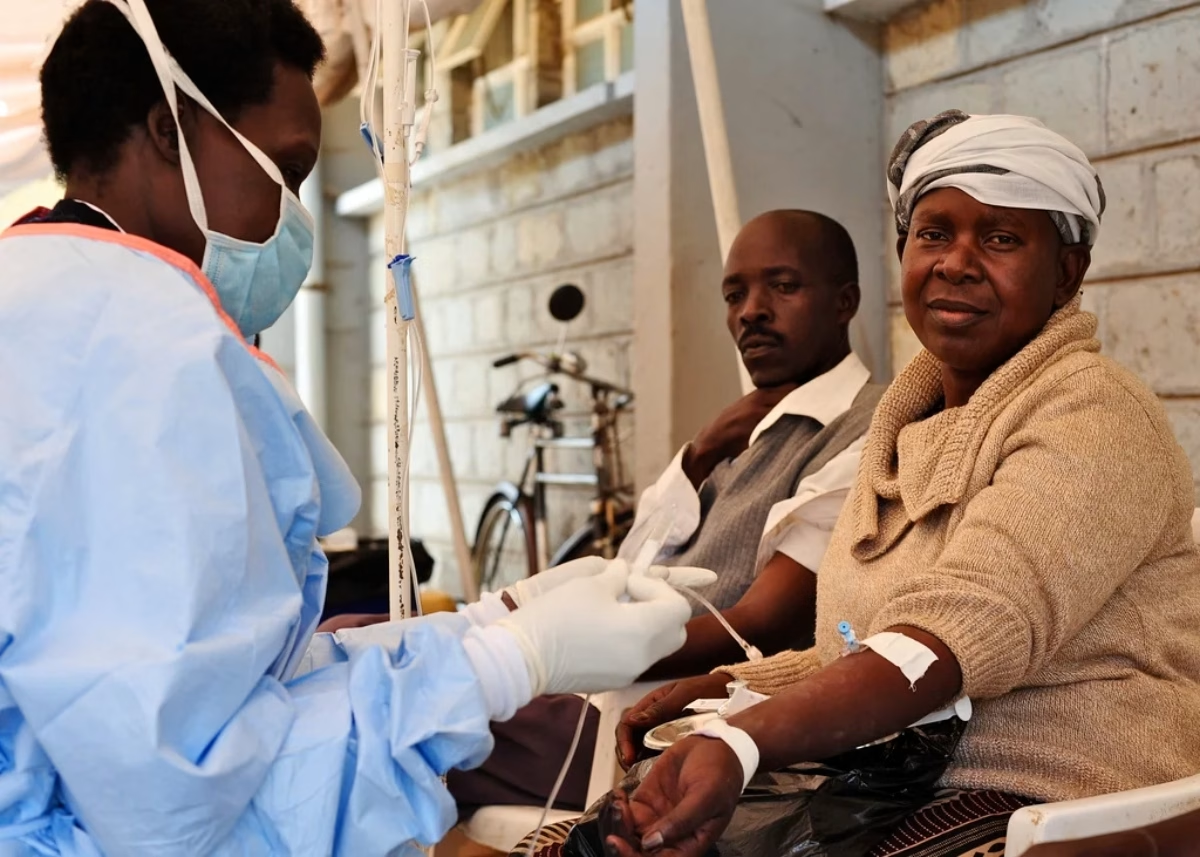
The Pfizer Foundation today announced a new three-year, $10 million investment through its Action & Impact: A Cancer Care Initiative to expand access to timely breast cancer diagnosis, treatment, and care. This funding will support efforts in Kenya by the Academic Model Providing Access to Healthcare (AMPATH), and in Ethiopia by Innovations in Healthcare in partnership with the Clinton Health Access Initiative (CHAI). Working with national ministries of health, the partners seek to improve breast cancer care in low-resource settings by promoting earlier diagnosis and helping address barriers that delay or prevent women from accessing treatment. With this commitment, The Pfizer Foundation’s investment in addressing breast cancer inequities now totals $25 million across five countries.
“Since the launch of the Action & Impact initiative, we’ve seen meaningful progress across Rwanda, Ghana, and Tanzania, empowering communities to lead the charge and helping women gain access to breast cancer care that once felt out of reach,” said Darren Back, President, The Pfizer Foundation. “As our trusted partners collaborate closely with governments to strengthen health systems, engage communities, and decentralize diagnosis and care, we’re helping build a successful model to help ensure more women can receive the care they need when and where they need it.”
Breast cancer is the most common cancer in sub-Saharan Africa,1 accounting for one in three (32%) new cancer cases in Ethiopia2 and one in six (16.1%) of all diagnosed cancers in Kenya.3 While the five-year survival rate for breast cancer exceeds 90% in many high-income countries, it averages just 40% in sub Saharan Africa due to barriers that delay diagnosis and limit access to treatment.4
“In Ethiopia, as in many other countries, breast cancer remains a significant public health challenge as many women are diagnosed in advanced stages and have limited access to treatment,” said Dr. Krishna Udayakumar, Executive Director, Innovations in Healthcare. “With The Pfizer Foundation’s support, we aim to partner with communities and health leaders to expand education, reduce stigma, and strengthen seamless and timely diagnosis and treatment, so that lifesaving care becomes the standard for every woman.”
“In the last decade, AMPATH partners have significantly grown our oncology program in Kenya from serving just 150 patients a year to more than 200 patients each day,” said Dr. Philip K. Kirwa, Chief Executive Officer, Moi Teaching and Referral Hospital, an AMPATH Kenya partner. “With this new grant funding, we will build on this success to not only help improve breast cancer outcomes for women in Kenya but also generate insights to inform national policy and catalyze sustainable improvements in cancer care across the region.”
Aligned with Pfizer’s broader purpose—to deliver breakthroughs that change patients’ lives—the Action & Impact initiative reflects The Pfizer Foundation’s mission to help build healthier communities by investing in community-led solutions to address today’s complex global health challenges. The initiative also builds
on the vision of Pfizer’s Accord for a Healthier World, which aims to expand access to quality care and close the health equity gap by enabling access to Pfizer’s full portfolio of medicines and vaccines for which Pfizer holds global rights on a not-for-profit basis to 45 lower-income countries around the world.
About The Pfizer Foundation
The mission of The Pfizer Foundation is to help build healthier communities around the world. We invest in community-led partnerships and solutions to address today’s complex global health challenges, respond to urgent health needs and empower Pfizer colleagues to make an impact where they live, work and beyond. The Pfizer Foundation is a charitable organization established by Pfizer Inc. and is a separate legal entity with distinct legal restrictions. To learn more, visit Pfizer.com/PfizerFoundation.
About AMPATH Kenya
AMPATH Kenya is a partnership between Moi University and Moi Teaching and Referral Hospital in Kenya and a consortium of 17 academic health centers around the world led by Indiana University. AMPATH improves the health of people in underserved communities by working in partnership with
academic health centers, ministries of health and others to build public sector health systems and promote well-being. Learn more at www.ampathkenya.org.
About Innovations in Healthcare
Innovations in Healthcare is a Duke-affiliated non-profit that works with 109 healthcare entrepreneurs in more than 90 countries and provides capacity-building training and consulting to healthcare systems throughout the world. We partner closely with the Duke Global Health Innovation Center (Duke GHIC), a center within Duke University, linking global health, health policy, and health innovation efforts across Duke to improve health. Together, Innovations in Healthcare and Duke GHIC improve access to quality, affordable healthcare worldwide.
About Clinton Health Access Initiative
The Clinton Health Access Initiative, Inc. (CHAI) is a global health organization committed to saving lives and improving health outcomes in low- and middle-income countries by enabling the government and private sector to strengthen and sustain quality health systems. For more information, please visit: www.clintonhealthaccess.org.
1 Ferlay J, Ervik M, Lam F, Laversanne M, Colombet M, Mery L, Piñeros M, Znaor A, Soerjomataram I, Bray F (2024). Global Cancer Observatory: Cancer Today. Lyon, France: International Agency for Research on Cancer. Available from: https://gco.iarc.who.int/today, accessed 20 November 2025
2 Tafese, A. M., Fentie, M. T., Seifu, B. L., Asnake, A. A., Dirbaba, B. D., Jara, A. G., Asare, E. T., & George, B. (2025). Breast cancer survival rates and determinants in Ethiopia: a systematic review and meta-analysis of longitudinal studies. BMC cancer, 25(1), 1263. https://doi.org/10.1186/s12885-025-14705-9
3 Republic of Kenya. (2021). Breast Cancer Screening and Early Diagnosis Plan 2021-2025 [Review of Breast Cancer Screening and Early Diagnosis Plan 2021-2025]. Ministry of Health. https://www.iccp
portal.org/sites/default/files/plans/Kenya%20Breast%20Cancer%20Action%20Plan%202021-2025_compressed.pdf 4“Addressing Inequities in Breast Cancer Treatment in Sub-Saharan Africa: Insights from a Breast Cancer Surgeon in Nairobi.” www.who.int/news-room/feature-stories/detail/addressing-inequities-in-breast-cancer-treatment-in-sub-saharan-africa–insights from-a-breast-cancer-surgeon-in-nairobi.