

By Kwabena Adu-Gyamfi
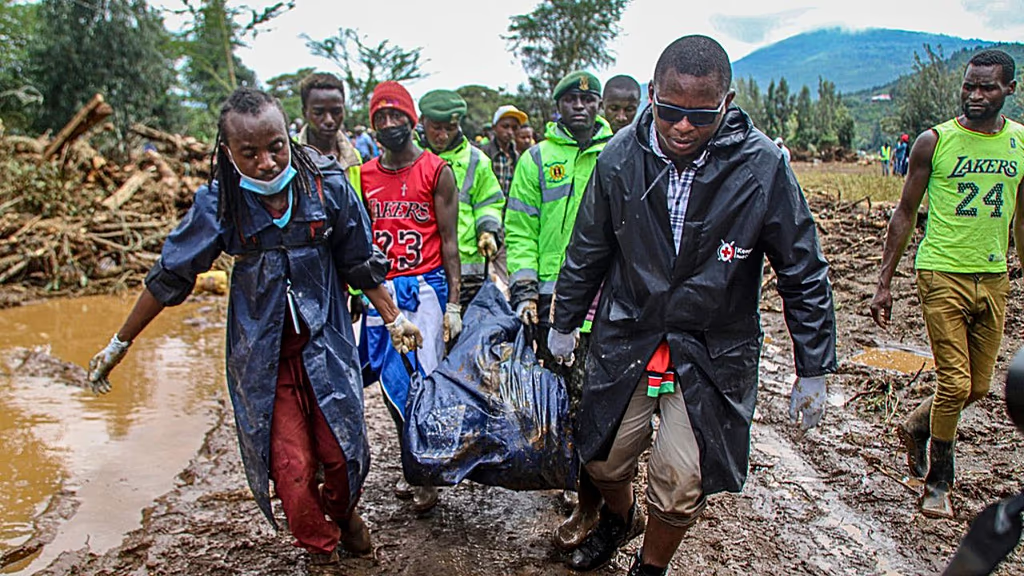
Africa has recorded the world’s fastest improvements in disaster resilience, a new major global study has revealed.
The research from Lloyd’s Register Foundation reveals that the African regions have made the strongest gains in people’s ability to withstand and recover from disasters and other major disruptions since 2023.
North Africa, for instance, recorded a five-point increase in resilience, followed by Southern Africa with four points. Eastern Africa and Central and Western Africa each improved by three points.
The gains were propelled by a mixture of expanding internet access, better household preparedness and improved financial resilience in countries including Algeria, Nigeria, Kenya, Egypt and Uganda.
The findings, however, expose a significant trial. In Central and Western Africa, few adults affected by disasters received any warning, raising questions about whether improvements in resilience are translating into better protection for vulnerable communities.
What is driving Africa’s progress?
This is the outcome of the fourth edition of the World Risk Poll, which surveyed more than 143,000 people across 140 countries and territories in the year 2025. Conducted by Gallup, the study examines the masses experiences of safety risks, also in countries where official data is limited.
Its Resilience Index measures people’s ability to absorb and recover from major shocks, using a scale of zero to 100. The assessment covers four areas: individual resilience, household preparedness, community support and wider societal conditions.
Increased internet access can help people obtain information about potential dangers, while household preparedness can improve their ability to respond when emergencies occur.
The researchers identified Algeria, Nigeria, Kenya, Egypt and Uganda among countries contributing to the regional improvements, although the factors behind the gains varied. The findings, however, do not in any way mean Africa has become the world’s most resilient continent. Rather, its regions have recorded the fastest improvements over the period examined.
… but why are millions still missing disaster warnings?
Despite the progress, the study discloses massive inequalities in access to potentially life-saving information. In Central and Western Africa, for instance, 47% of adults affected by disasters said they had received a warning.
Globally, people in low-income countries were almost twice as likely to have experienced a disaster over the previous five years as those in high-income countries.
Nearly one in three adults in poorer countries reported being affected, compared with 16% in wealthier nations.
Yet only 64% of disaster-affected adults in low-income countries received warnings, compared with 84% in high-income countries. Even when warnings were issued, many people were unable to respond.
Fewer than half of warned adults in low- and lower-middle-income countries managed to take action before disaster struck, compared with 71% in high-income countries.
Nancy Hey, director of evidence and insight at Lloyd’s Register Foundation’s Global Safety Evidence Centre, said the results highlighted the importance of preparedness.
“A warning is only as good as what people can do with it,” she said.
Can mobile phones help save more lives?
The research identifies mobile technology as a major opportunity to close gaps in disaster warning systems.
Worldwide, an estimated 1.1 billion adults experienced a disaster in the previous five years, but almost 220 million received no warning beforehand.
Of those who were not warned, 77% owned a mobile phone, equivalent to more than 170 million people.
The study also found that people were more likely to act when warnings reached them through several channels.
Only 37% of those receiving alerts through one channel took action, compared with 51% reached through two and 64% through three. These channels include text messages, television and social media.
Lessons from Malawi
The importance of local preparedness is already evident in parts of Africa.
In Malawi, volunteers mobilised communities to clear storm drains ahead of extreme rainfall in January, according to the International Federation of Red Cross and Red Crescent Societies.
This initiative illustrates how communities can take practical steps before severe weather arrives.
Caroline Zastiral, acting global lead for disaster risk reduction and resilience, said effective warnings depended on people’s ability to respond.
“Warnings lead to action when people have the trust, knowledge, time and resources to protect themselves, their loved ones and their assets,” she said.
A challenge for rich and poor countries alike
While the study highlights the greater exposure of poorer countries to disasters, especially amid climate change, it also challenges the assumption that national wealth necessarily makes people more resilient.
The research further states that globally, societal resilience, which includes trust in national institutions, rose from 63 points in 2021 to a record 66 in 2025. However, Individual resilience fell from 46 to 42, its lowest recorded level.
What is next?
Lloyd’s Register Foundation is urging governments and disaster management agencies to widen warning coverage and invest more in household preparedness.
Dr Andrew Tupper, chief of the Early Warning Services Section at the World Meteorological Organisation, said warnings must be part of a broader system that helps communities to respond.
“An early warning system is useless if it doesn’t empower people to act,” he said.
For Africa, the latest findings offer a mixed but important picture. The continent’s regions are making some of the world’s strongest gains in resilience, indicating that improvements in connectivity, proper household and community planning, and financial preparedness are making a difference.