

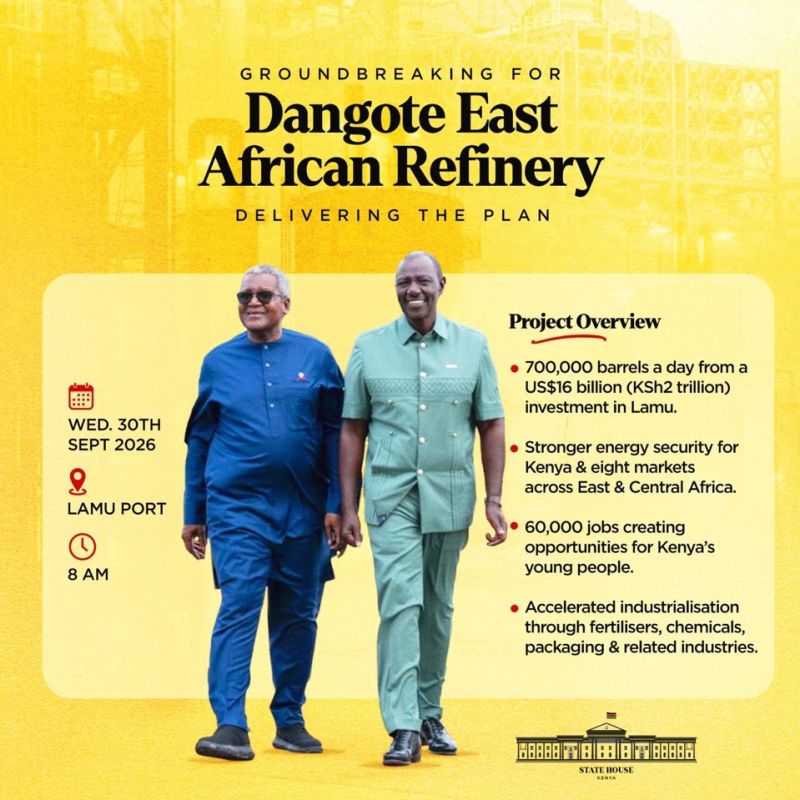
Dangote Petroleum & Petrochemicals was due to break ground this week in Lamu on a proposed 700,000 bpd refinery costing between $16bn and $20bn, but the project has now been dragged to court.
For Dangote, this is essentially a replication of his Lagos model in East Africa. Just that this time he has made it an equity and debt structure where regional governments have been offered up to 30% equity and Kenya allocated 10%.
On a $16bn project, that implies roughly $4.8bn equity and $11.2bn debt.However this is not the trigger of the frustration but the conditions that came with this;
Dangote is said to have requested that Kenya provides land, support regional financing and create a policy framework that gives the refinery a stable market.
Given these conditions Kenyans are demanding answers to four fundamental questions:
1. What exactly is Kenya giving up for its 10%?
If Kenya contributes cash + land + roads + port infrastructure + tax incentives + guarantees + market protection, those contributions must be valued.
Otherwise, how do they know 10% represents fair value?This is the transparency they want from Ruto.
It appears the numbers need reconciling given that the project is projected to cost around $16bn, while Kenya’s 10% stake has also been discussed against a broader KSh2 trillion valuation.
2. Who carries the downside if 700,000 bpd isn’t achieved?
A refinery of this scale needs enormous volumes of crude. Kenya doesn’t produce anything remotely close to that.
With Uganda’s crude increasingly committed to Tanzania through EACOP and South Sudan’s supply route uncertain, Lamu could depend heavily on imported crude.
So who absorbs the risk of crude price spikes, shipping costs, supply shortages, under-utilisation and weaker refining margins?
3. What exactly does Dangote mean by a “stable market”?
Dangote has said Kenya needs policies to protect the refinery from cheap imported fuel.That raises a fundamental distinction:
“Is he building it to compete.”
Or:
“building it then force the Kenyan government to ensure there is a market?”
Those are two very different commercial propositions Kenyans need answered.
4. Why Lamu when Uganda’s crude is heading towards Tanzania?
Besides the deep waters that allow ships to bring crude for refining,Dangote knows that he isn’t entering an empty market.
Lamu is potentially positioning itself as a competing East African energy hub against Tanzania + EACOP + Uganda, with Uganda developing its own Hoima refinery while its crude flows towards Tanzania.
So is this merely a refinery project or a battle over who controls East Africa’s future fuel and energy corridor?
This is why the commercial terms, risk allocation and government commitments need to be in the open given the size of the transaction.